


Share
Indonesia’s energy efficiency transition is not constrained by technology availability. Proven solutions exist. Capable service providers are present. Capital is not absent. Yet the market continues to move more slowly than its technical potential would suggest.
The constraints are arguably more institutional than technological. Challenges such as uneven technical capacity across market actors, persistent uncertainty around the bankability of energy efficiency projects, fragmented trust in Energy Service Companies (ESCOs)—providers of energy efficiency services, as well as limited experience in designing and enforcing legally binding energy efficiency performance contracts known as Energy Savings Performance Contracts (ESPCs), continue to persist.
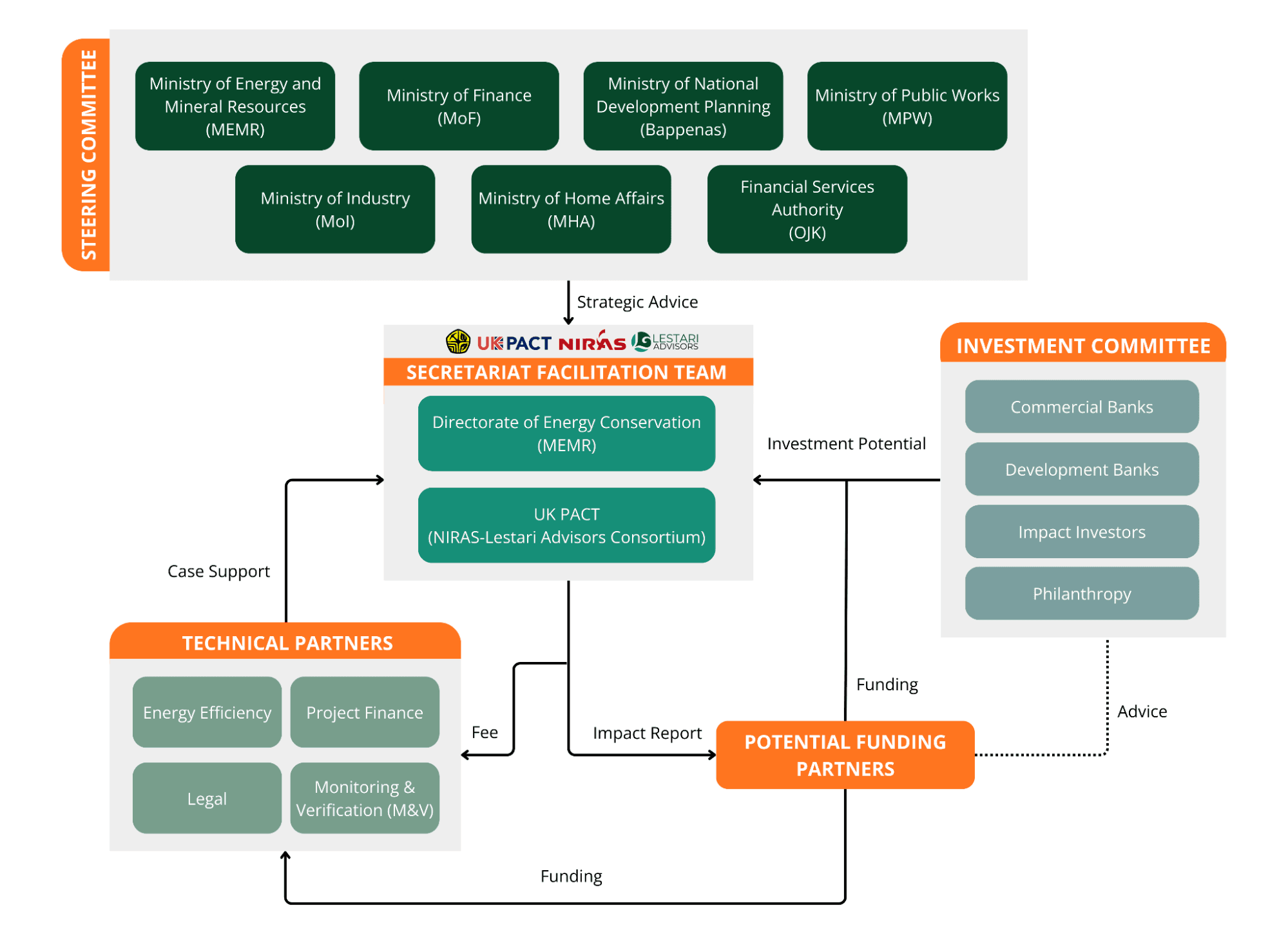
It is within this context that Lestari Advisors operates the Energy Efficiency Project and ESCO Investment Incubator Secretariat under the TENAGA-i (Transforming Energy Efficiency Networks and Green Acceleration through Investment) initiative, in partnership with NIRAS International Consulting. TENAGA-i represents more than a temporary, one-off project. It is a solution aimed at easing the friction points of a transitioning market where capability gaps, coordination failures, and investment uncertainty intersect, while contributing to the strengthening of institutional infrastructure that enables sustainable finance to flow at scale.
Hosted by the Indonesian Ministry of Energy and Mineral Resources and supported by the UK Government through UK PACT (Partnering for Accelerated Climate Transitions), the Secretariat is operated by a consortium consisting of NIRAS and Lestari Advisors. Its mandate is straightforward and systemically significant: to support the development of a pipeline of bankable energy efficiency projects, strengthen ecosystem capabilities, build the capacity of key market actors, and improve investor confidence through structured incubation and coordination.
A crucial development in the institutional framework is the ownership of the Secretariat. It rests with the Ministry itself, as stipulated in the Ministerial Decree of MEMR (Kepmen ESDM) No. 32.2/EK.07/DJE/2026. This anchoring within government structures ensures continuity beyond the lifecycle of project-based funding, increasing the likelihood that the mechanisms, relationships, and capacities being built will endure and evolve over time. In practice, the Secretariat functions as a durable coordination hub facilitating collaboration across public and private actors and enabling sustained market transformation.
For Lestari, operating this Secretariat aligns closely with how we approach ecosystem development. Our institutional approach—built around aligning actors, clarifying strategy, strengthening capabilities, and catalyzing implementation—is not an abstract framework. It is intended to guide real interventions in complex policy and finance environments. The Secretariat provides a practical setting in which this approach can be translated into action.
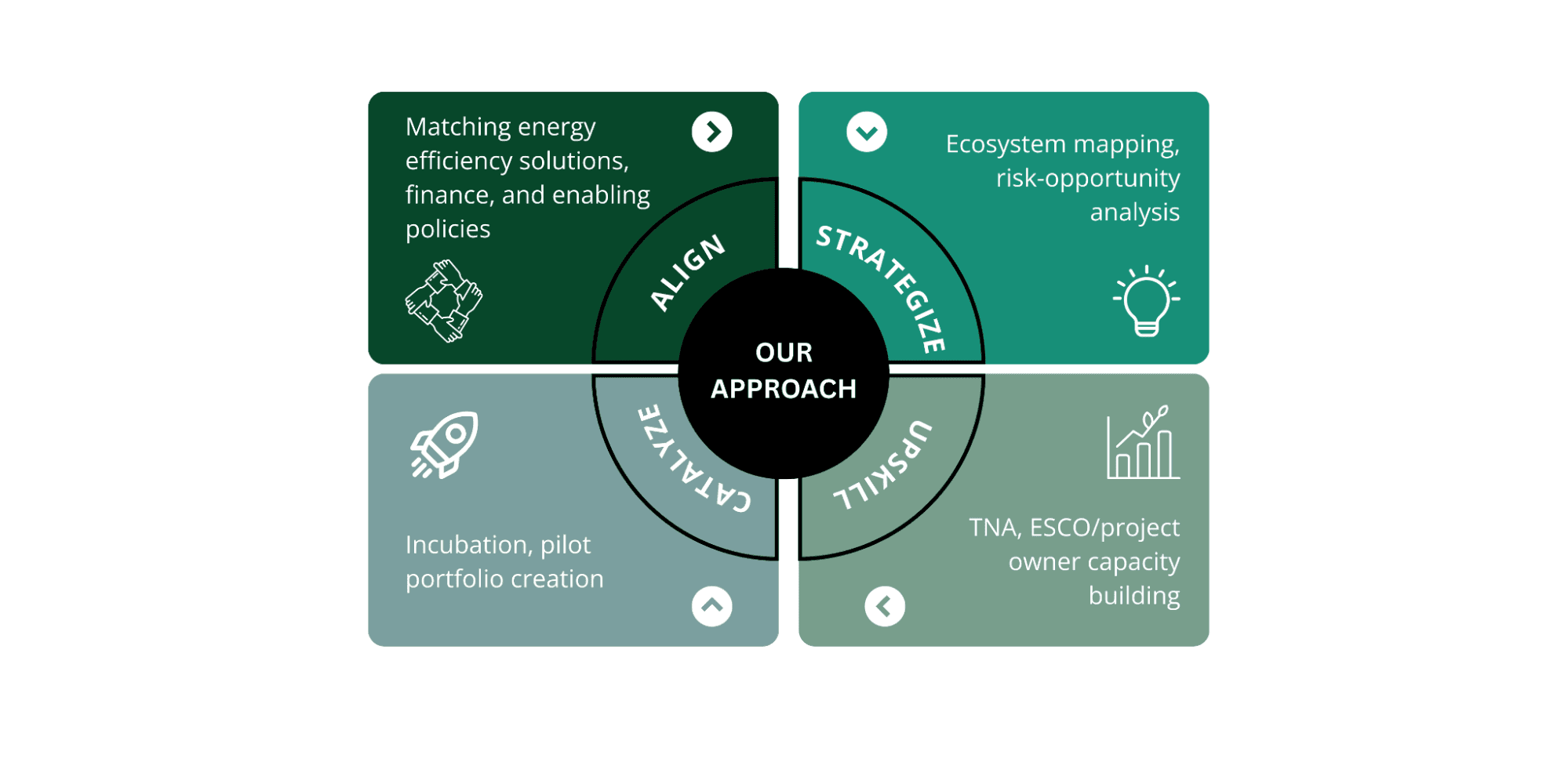
Operating in this space requires adopting a role distinct from traditional advisory services. Rather than acting solely as technical, financial, or legal consultants, we function as ecosystem operators. We coordinate stakeholders, facilitate translation across institutional perspectives, structure collaboration, and maintain continuity between policy intent and market execution. This positioning demands both analytical discipline and relational navigation, particularly when aligning incentives across actors whose objectives and constraints differ.
Our partnership with NIRAS reflects this multidimensional requirement. The collaboration combines complementary strengths in technical programme delivery, international experience, and local ecosystem embeddedness, allowing the Secretariat to operate with both depth and contextual responsiveness. This model underscores an important principle: complex transitions are rarely enabled by single actors. They require structured collaboration capable of integrating diverse forms of expertise and institutional access.
- Through operating the Secretariat, several observations have become clearer:
Market readiness remains uneven, and capacity gaps are often deeper than surface diagnostics suggest. - Bankability challenges extend beyond financial structuring into institutional confidence and project preparation maturity.
- Trust in contractual models, measurement frameworks, and delivery capabilities remains a central determinant of adoption.
- Addressing these dynamics requires sustained ecosystem engagement rather than short-term interventions. From this, we see the institutionalized Secretariat’s role becoming increasingly essential.
The long-term vision of the Secretariat has the potential to strengthen broader institutional confidence that progress in Indonesia’s energy efficiency markets is underway and, ultimately, enable the scaled deployment of inclusive energy efficiency measures. This, in turn, contributes to wider climate impact by delivering the emissions reductions required for Indonesia to reach peak emissions by 2030 and achieve Net-Zero Emissions by 2060 or sooner in the energy sector, while ensuring that the benefits of efficiency—including cost savings, improved energy services, and reduced emissions—are shared across stakeholders, including smaller enterprises and underserved communities.
Furthermore, the Secretariat serves beyond being a government program limited to the energy efficiency sector alone, acting instead as a prototype for how transition market infrastructure can be designed and governed. The institutional architecture being exercised here has potential relevance beyond energy efficiency, including applications in industrial and building decarbonisation and distributed energy system development. As Indonesia’s sustainable finance landscape evolves, mechanisms that bridge policy, technical capability, and capital mobilization will become increasingly essential.
For Lestari Advisors, this experience contributes to an ongoing institutional evolution. Operating the Secretariat represents a step beyond advising toward actively shaping the conditions under which markets function. It reflects a broader trajectory in which our role extends from advisory provider to ecosystem architect who designs and sustains the connective structures that enable systemic transformation.
Engaging in this work carries both privilege and responsibility. Operating within the intersections of policy, finance, and implementation provides visibility into the complexities of transition processes and the opportunity to contribute constructively to their progression. We remain committed to supporting the development of institutional environments where sustainable investment can occur with clarity, confidence, and long-term impact. Not through isolated projects, but through ecosystems capable of sustaining change.